Plays here from YouTube when you press play. Open on YouTube
Published . Prices, rates and counts in this video were current on that date. This month's numbers are on Market Data. Terence Richardson joined Compass in September 2025, after this video was published.
What is this video about?
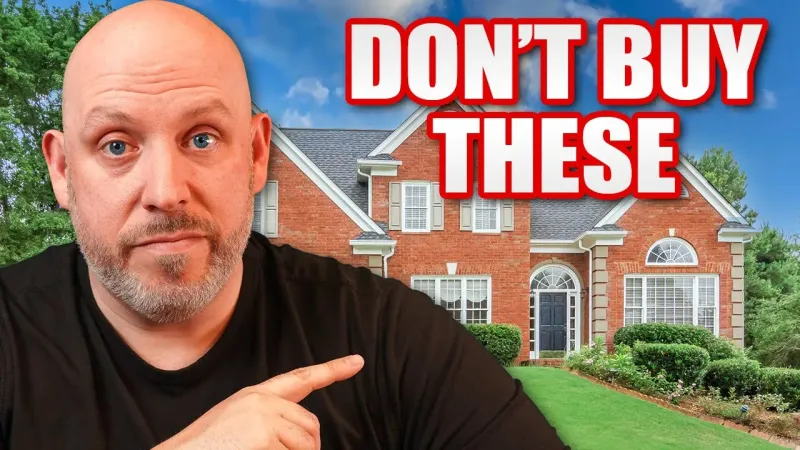
“NEVER Buy These Types of Houses in Georgia” is a 14-minute video by Terence Richardson, a Realtor with Compass in Metro Atlanta. It was published on July 23, 2025 on his YouTube channel, Terence Richardson - Atlanta Real Estate.
I've seen thousands of houses over the last 15 years and there are 5 types of houses I would NEVER buy.
Transcript
This is the caption file published with the video, set into paragraphs. Place names the captions misspelled were corrected. Nothing else was added or reworded. Captions can still mishear a word or a number, so check a figure against the video before you rely on it. Captions read November 16, 2026.
Never Buy These Types of Houses in Georgia 0:00
There are homes in the market right now in Georgia that I would not wish upon my worst enemy. Yet, most buyers have no idea what they're walking into. Now, I've toured thousands of homes in Georgia, and when I walk into one of these types of homes, I know right away not worth it. So, I'm going to break down the five major types of houses that I personally would never buy. And I'm going to show you the red flags that I look for so that you never unknowingly buy one of these houses.
Type of House 1 0:27
Let's jump right into it. Let's kick things off looking at external environmental factors. Because let's be honest, when you find that beautiful house online and you go see it in person, the last thing most people are looking at is what's around that house. Why? Because you're focused on the actual house. You've got tunnel vision. But I'm going to tell you, it's extremely important to find out what's happening around that property. I helped clients just a couple years ago.
They bought a house in Acworth with a different agent. They had gone to see this house over the course of the weekend. They had their home inspection also on the weekend. They didn't go back to the house until the final walkthrough. And on the final walkthrough, on the day of closing, they heard all this noise, all this racket behind the house. Come to find out, there's a business off of Baker Road in Acworth that basically chops up wood.
They cut down trees, bring it back to this facility, and they turn it into mulch. So all day long, the only thing that you're hearing are the wood chippers going and that's right behind their house. They tried to live with it for a couple of years, but the noise was just too much and they ended up reselling. When you took a look at that neighborhood, a lot of these homes tend to resell over and over and over.
So what other environmental factors immediately spring to mind in Atlanta, home of the world's busiest airport? If you're thinking about Hartsfield-Jackson, you would be absolutely right. What comes with that? A constant onslaught of planes taking off and landing throughout most of the day. And when you get close to the airport, you've got all of these communities that are immediately around it that are in the flight path where literally every 48 to 60 seconds, there's a plane flying over the neighborhood on takeoff.
Now, a lot of people will tell you that when they buy a house in an area like this, they don't even hear the planes after a while. Why? Because your reticular activating system no longer alerts you to the threat. But what happens when you go to resell and you've got buyers coming in from all over to look at the house and that's the first thing that they notice is oh plane. Oh plane and some of these houses you actually feel the houses shake as the bigger planes take off.
It's significant and it does affect resale value. And then we've got railroads. Atlanta was built on railroads. We were called terminus at one point. Why? Because all of these different railroad companies had their lines terminate in Atlanta. Well, Atlanta is still a vibrant hub for rail business today. Both CSX and Norfolk Southern have very active lines that run throughout metro Atlanta. And when I first moved here personally, I bought a house in Acworth.
And in Acworth, I wasn't too far away from Legacy Park. Legacy Park in Kennesaw has a rail line that literally goes right behind it. And there are a couple of train crossings that go over roads where the train has to blow its whistle. I was a half mile away and I heard that train sound at all hours of the day and all hours of the night. So, would I do it today?
No. I would never buy another house that close to a rail line. Next, let's talk about road noise, specifically interstates, because quite frankly, we have a lot of them in metro Atlanta. 285 is a road that never sleeps. It's the Las Vegas of Atlanta. I'd like to say that what happens on 285 stays on 285, but it ends up on Instagram and all over the news. Look, when it comes to being close to major thoroughares like that, don't do it.
Save yourself the trouble. These homes don't sell for as much on resale. They take a lot longer to resell. They're going to be a pain in your butt forever. Next, we've got industrial zones. Atlanta with all these interstates. It makes it a really great location for warehouses. Think of Amazon with their 12 million distribution centers. So, you've got the big trucks that come in, the small ones that go out, and that's constant constant traffic.
Then we've got police stations, fire stations, hospitals, those sort of things. Much needed services. Every community needs them, right? Don't recommend buying a house right beside one of those because you will get tired of the sirens every time there's an emergency. And you've got homes with high tension wires and 5G cell phone towers. And it doesn't matter how many cell phone towers they try to make look like overgrown Christmas trees, it still doesn't help resell.
Don't do it. Now, you've got recycling centers, waste transfer centers. I think those are pretty obvious. And then there are schools. Now, schools are one of the most important factors to consider when you're buying and selling. But here's a question for you. Would you want to buy a house and live immediately across a school or right beside one? Because morning drop off and afternoon pickup is going to be very, very busy.
And then like for example, if it's a high school, you've got Friday night lights, you've got activities over the course of the weekend. There's always people coming and going. Drop a comment and let me know what your thoughts are. Now, I personally wouldn't live across from one or beside. I I where I live today, I bought this house because I wanted to be in a good school district. So, it matters. I just don't want to be across the street from one.
Now, before we move on, there's one last thing that I want to talk about in terms of environmental factors. something that happened 15 years ago that even to this day means that I would never buy a house if it's in one of these specific areas. So in 2009, in September of 2009, it rained for nine consecutive days in Atlanta. And then on the 20th of September, we had 21 in of rain in 24 hours.
Well, everything was already ultra saturated. And then you have this onslaught of this deluge of water everywhere. Well, needless to say, it caused flooding everywhere. I remember being on the ground trying to drive to go and check it out in Acworth and there was a bridge that was taken out. There was water going through. It's uh there was a whole neighborhood that was already underwater and that's just what I personally experienced.
And there are people that experienced far worse. 16 people lost their lives during this flooding. There were schools that were completely underwater. You look at Cobb County, Douglas County, Paulding, Carroll County, parts of Gwinnett, parts of Vintown. The interstate was underwater. It doesn't matter that it was 15 years ago. I personally would never ever buy a house in one of these areas because weather today is way too unpredictable. And even though it was a 500year flood, I don't think that we're beyond seeing another 500year flood in our lifetime.
I just wouldn't do it. So, with these environmental factors, the best thing that you can do is take a look at Google Maps and zoom out a little bit and then see what's happening around a given house. And I also think it's a really great idea to talk to neighbors because neighbors talk. They tend to know what's happening in a neighborhood. You don't just want the house to be awesome. You want the neighborhood to be awesome as well.
You don't want to deal with some of these environmental factors on resell. There's so much you need to be mindful of when you're buying a house. Wouldn't it be nice if there was some kind of a checklist that would help you with these red flags? Well, I've got you. In the description and in that first comment, I've got a checklist of the 21 red flags that you can spot in 60 seconds.
Go ahead and download it. It's yours if you want it. Now, the next type of house that we're going to look at are money pits. And I'm talking about houses that just drain your budget from day one, even if they look like a steal. Now, there are certain types of houses that I could be convinced to buy, but there are other ones that are just not worth it.
Type of House 2 7:54
So, let's dive into what those might be. Now, this next type of house is a house that's going to be a little bit more affordable. So, they are appealing to first-time home buyers. They're definitely appealing to people that are DIY people, but they often end up being big money pits. So, what am I talking about? I'm talking about the homes that were built in the 80s and 90s that have aging roofs, HVAC, windows, and siding, right?
Even water heaters. But water heaters aren't the end of the world. You're spending 2 to 3K to replace one. But a roof is anywhere from 8 to 20,000. HVAC, if it's one system, it's 8 to 12,000. Multiple systems, multiply that number, right? Right? If you're in a two or three system house, you're looking at anywhere from 24 to 36,000. During the '90s, a lot of houses were put up really, really quickly, especially as Atlanta was going through the Olympic boom.
A lot of builders put in extremely cheap vinyl builder grade windows. So, the windows are all fogged up, for example. Have you checked to see what window replacements cost nowadays? It's not cheap. Like, you could spend easily 20 to $30,000 to replace windows in a house. If I walk up to a house and it has Louisiana Pacific siding on it, unless the house is a screaming deal, I'm not going to buy it.
It's extremely expensive to replace siding. And a significant amount of houses in metro Atlanta, unfortunately, have LP siding. It was everywhere in the 80s and 90s. A lot of the houses still have it today. That's a big nope for me. Next are roofs with Atlas Chalet shingles. Now, Atlas Chalet, you'll have roofers literally knocking on your door offering to help you get it replaced via insurance, but not all insurance companies will replace Atlas Chalet.
Atlas Chalet looks like an architectural shingle, but it's not. There's ways of telling when you look at the lines. It's a little bit too uniform. Now, Atlas Chalet was supposed to last 30 years, but it started to fail after only a couple. New roof 8 to 12 to 20,000 depending on the size of the house, right? So, just keep that in mind. It's not a good product. Next are homes with polybutylene piping or polyb as many people call them.
Now with polyb it's not a question of if it's going to fail, it's a question of when. They went through three different iterations. All three have failed, hence class action lawsuits. You're looking for gray pipe, sometimes bluish gray. They have these elbows with these brass fittings, and that's most commonly where the points of failure are. Now, while the cost of replacing Polybe might not be as much as a dual system HVAC system, it's still not insignificant.
On the low end, you're looking at5 to $6,000 for a very small house. Talking about like a twob kind of house with the kitchen to many multiples of thousands the more bathrooms and sinks you have. So, it's it's a cost that can run up pretty significantly pretty quickly. Now, the next type of house I'm personally not interested in buying is one that has synthetic stucco. I might be convinced to buy a house that has hard coat stucco, but synthetic, no thank you.
Synthetic, unfortunately, is prone to moisture issues. So, how do you tell if you're looking at hard coat versus synthetic? Easy. You go up and you tap on it. Literally, you go up and you knock on it. If it sounds hollow, chances are you've got synthetic stucco. So, I mentioned visually what to look out for, but also if you take a look at the age of the house, you can get a lot of information about whether or not it might have been built with these products.
LP siding was 1985 to 1996. Polybeine piping was 78 to95. Atlas chalet shingles 97 to 2002. And synthetic stucco 1980s all the way to the early 2000s. If you're considering a house that looks like a fixer upper, but they're charging you a regular price for it, I would just walk away. Now, the next type of house that I'm personally not buying is an investor flip. Unless I know the investor and the quality of their work.
If I know they're not cutting corners, I would consider it.
Type of House 3 11:57
But way too many investors do. Look, I'm not interested in buying a house from someone who took a weekend seminar from some internet guru and how to flip a house. Most of the time, these flippers, what they're doing is they're putting lipstick on a pig. They're going to do the cosmetic stuff that looks good, but the stuff, the meat and bones of the property never get addressed. They just get hidden. So, what about considering a house that's on the market that was previously flipped?
Well, I think the biggest red flag there is if that house has been resold in a short period of time. Statistically speaking, talked about it a little bit earlier in the video. People are staying in their properties on average for 8 to 10 years. So, I've got a list of houses here that I found that have been sold at least four times in the last four to 5 years. That's not normal.
Something's going on. Now, this next one has to do with buying a house with bad neighbors. Now, you can't pick your neighbors after you close, but you can do more upfront due diligence before you ever make that purchase.
Type of House 4 12:55
So, what am I talking about exactly? Well, you go see the house that you want to see get there. That house is gorgeous. The neighbor's house, not so much. Either it's in advanced stages of disrepair, the lawn's overgrown, maybe there's a junk car, you know, there's trash everywhere. That neighbor has clearly lived there a long time. they're probably going to outlive you living in that house. And when you go to resell yours, the next buyer coming through is going to see that and go hard pass.
So, I just don't recommend buying houses like that. Next are properties that have bad lots. Now, you might have a beautiful house, but if the lot's bad, it's still a bad deal. So, what am I talking about? First and foremost, I'm talking about the houses with driveways that remind you of Mount Everest.
Type of House 5 13:41
If you have to go up Mount Everest to get to your house, the next buyer that you're going to try and sell the house to won't like that. It's going to affect resell. I wouldn't do it. Now, the same is true for houses where you drive down the Grand Canyon to get to the house when you've got those big slopes down. Also, a problem is potential waterhed around the property with those type of uh lots, right?
The water is going to flow towards the house. Well, that could mean water getting into the basement. It could be mean structural issues. There's a whole host of problems that that could potentially open up. Don't do it. If you're going to watch more videos today, YouTube definitely thinks you should watch this one next. Thank you so much for watching and I hope to see you on the next

About Terence Richardson
Terence Richardson is a Realtor with Compass and the founder of the Terence Richardson Group, which serves Metro Atlanta. He publishes Atlanta’s Housing Market Update every month on YouTube and in The Richardson Report.