Plays here from YouTube when you press play. Open on YouTube
Published . Prices, rates and counts in this video were current on that date. This month's numbers are on Market Data.
What is this video about?
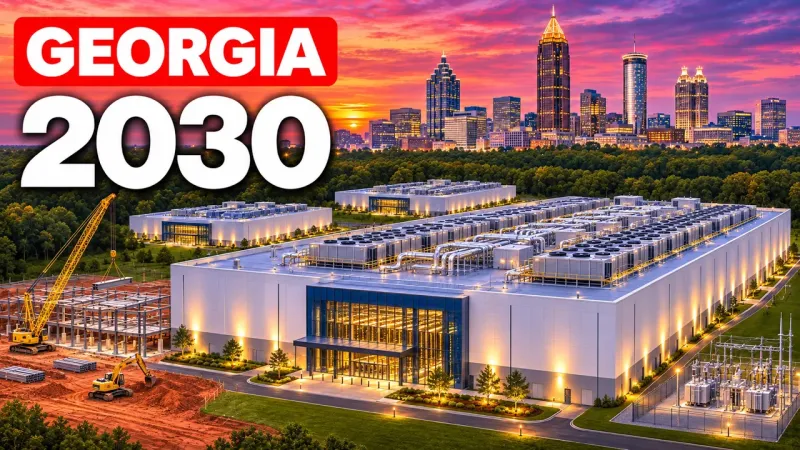
“Georgia’s 13 Mega-Projects: UNRECOGNIZABLE by 2030” is a 22-minute video by Terence Richardson, a Realtor with Compass in Metro Atlanta. It was published on November 8, 2026 on his YouTube channel, Terence Richardson - Atlanta Real Estate.
About 1 in 5 Americans don't have an opinion about Georgia at all. The rest think it's just Atlanta and a whole lot of peaches. By 2030, 13 mega-projects are about to make parts of this state unrecognizable, and change where you can afford to live.
So I went through the public records on all 13, plus the Census data and home prices around most of them, and ranked them by how much each one changes where you live and what you pay. Which ones are real, which ones are behind, which ones are already dead, and the one corner of Georgia that's going to be unrecognizable.
Transcript
This comes from YouTube’s automatic captions, set into paragraphs. Place names the captions misspelled were corrected. One figure the captions misheard was corrected after checking it against the video’s script or a second transcription. Nothing else was added or reworded. Captions can still mishear a word or a number, so check a figure against the video before you rely on it. Captions read November 16, 2026.
13 projects changing Georgia by 2030 0:00
About one in five Americans don't have an opinion about Georgia at all. The rest think that Georgia is just Atlanta and then a whole lot of peaches. By 2030 that changes. 13 mega projects are about to make parts of this state unrecognizable and change where you can afford to live. Outside Savannah, Hyundai's $7.6 billion car and battery complex. On I-20, a $5 billion Rivian factory. In Effingham County an OpenAI campus signed for three large nuclear reactors worth of power and most of them aren't even in Atlanta.
So I went through the public records on all 13 plus the census data and home prices around most of them. I ranked them by how much each one changes where you live and what you pay. By the end of this video you'll know which ones are real, which ones are behind, and which ones are already dead. And the one corner of Georgia that's going to be completely unrecognizable by 2030.
Number 13: The Okefenokee 0:57
Number 13 on this list is the only project that's about what won't get built. For years a mining company called Twin Pines tried to mine right next to the Okefenokee Swamp down near the Florida line. In 2025 a conservation group bought that land for $60 million. New tonight a conservation group says it has reached a $60 million deal to buy land outside the Okefenokee Swamp. The mine is done. And this July Okefenokee became Georgia's first UNESCO World Heritage Site ever.
More than 800,000 people already visit every single year. Now here's the part the press releases leave out. Conservation groups want another 25,000 acres of that same ridge protected. It isn't yet. So why is a swamp on a real estate channel? Well, because if you know where growth can't go, you know where it's going to go instead. So that's where growth can't go. But what happens when a car plant shows up?
Number 12: Kia and West Point 1:52
Number 12 Kia in West Point. Kia rolled its first Georgia built car off the line in November 2009. the same year I moved to Atlanta. Since then, more than 5 million cars have been built there. And in October, Hyundai Transys announced another 560 million and 320 jobs right next door. So you'd think Troup County would be booming, right? Take a look at this. Since 2020 in Troup County grew 4.9%. The state of Georgia grew 5.5% and the city of West Point actually lost people.
Home prices up 68% since 2019. Meanwhile, Gwinnett with no car plants grew by 64%. Now, to be fair, new home permits have more than doubled there since 2019. Something is finally starting 15 years in. So the jobs came, the boom didn't, not yet anyways. But keep Troup County in your head.
Number 11: Augusta and Fort Gordon 2:49
It's going to matter at number three. Number 11 is in Augusta and the growth went somewhere you wouldn't expect. More on that in a second. Fort Gordon is where the Army trains its signal and cyber soldiers, about 20,000 a year. And the Army is building a new cyber campus there that they call the largest military construction program in the continental US. More than 1.6 billion dollars finishing in 2028. Fun fact, the base changed name twice in less than two years.
Fort Gordon, then Fort Eisenhower, now back to Fort Gordon again. Now here's what's really interesting for housing. Since 2020, Richmond County where most of Augusta sits is basically flat, down 43 people. Columbia County right next door added more than 13,000. Grovetown alone is up 15%. Look, Columbia County was Augusta's suburb of choice before any of this. So I wouldn't give the cyber campus all of the credit, but the people are landing across the county line.
So the people follow the jobs, just not always the town with the jobs. And the factories, that's where it gets really interesting.
Number 10: The battery belt 3:54
Number 10. Did you know that Georgia has two Hyundai battery plants on opposite ends of the state? People mix them up all the time. This one in Bartow County near Cartersville is a $5 billion plant with SK on with more than 3,500 jobs projected. It started producing in June. And right down the road, Qcells started making solar cells in Cartersville the same month, about a year late. So, what's it doing to the area?
Take a look at Bartow. It was the ninth fastest growing county in Georgia last year, and home prices are up 75% since 2019. Now, here's the twist. Qcells has been in Dalton since 2019, and Whitfield County has grown 3.2% since 2020. That's less than the state. So, a factory by itself doesn't move a county. Bartow is part of Metro Atlanta by the Census Bureau's count. Dalton isn't. That might be my read on the difference.
And one more for Northwest Georgia. In September, Pirelli announced a $1.2 billion investment in Rome, but hiring there doesn't start until 2029. So, that's the factories, but there's one project on this list that almost everybody in Georgia uses.
Number 9: Hartsfield-Jackson 5:05
Number nine, Hartsfield-Jackson. Still the busiest airport in the world, 106 million passengers last year. And right now, they're widening Concourse D while it's open. The new sections get built offsite, then rolled in overnight. $1.4 billion, about halfway done, finishing in 2029. And next year, they expect to be doing about a million dollars of construction every single day. Now, here's the catch. Passenger traffic actually dipped 1.6% last year. And the six runway people talked about for years, that's not happening anymore.
So, no new runway, just a wider and little bit less crowded concourse. And if you've ever walked Concourse D at 5:00 p.m., you'll take it.
Detour: Announced isn't built 5:48
Now, before the top eight, a quick detour because I promised you the ones that already died, right? Remember Spaceport Camden, a rocket launch site on the coast? Voters killed it in 2022, and by 2023, it was officially over. Freyr, a $2.6 billion dollar battery plant near Newnan, 720 jobs promised, cancelled in January 2025. That high-speed rail from Atlanta to Charlotte, approved on paper in 2021, no money to build it. And Georgia's film industry, well, production spending fell from $4.4 billion to $2 billion in just four years.
So here's my rule. An announcement is a press release. Steel in the ground, well, that's a project and that's worth talking about. Which brings me to the one that landed while I was editing this video. In October 2026, Audi picked Georgia for its first US plant, about a $4 billion investment and 4,500 jobs in Peach County south of Macon. But that's still a press release. Grading starts in 2027 and full production isn't expected until 2031.
So does it make the countdown? Not yet. And if there's a project in your part of Georgia that you think is real or one that you think is dead, tell me in the comments.
Number 8: Data centers 7:04
I read every single one. Number eight, and I already know this one's going to light up the comments, data centers. People feel really, really strongly about them. But here's what most people don't realize. In 2024, Metro Atlanta did something no market has ever done. It beat Northern Virginia for new data center space leased in a single year. And right now, Metro Atlanta has more data center capacity under construction than any other major market in the country, even Northern Virginia.
And the power they want, it's staggering. Georgia Power's list of big new customers asking for power adds up to 76 gigawatts. In October 2023, it was 17. So it's more than quadrupled. About 12 of those gigawatts are actually signed and 26 of the 31 customers who signed, well, they're data centers. Customers have already broken ground on 8,500 megawatts of it and 10 projects are online. Now, the money. Amazon announced $11 billion in Butts and Douglas counties.
In Butts County alone, that's about a dozen data centers. And one of Microsoft's AI super factories is already running in Fayetteville. The promise is jobs and tax money. Amazon says more than 550 jobs, and Butts County expects its share of the payments to be about 16.5 million in 2027. Look, here's where I'd be a little bit careful. That's $11 billion for about 550 jobs. And Georgia also gives data centers a break on sales tax.
In fiscal 2025, that cost the state $474 million. And the state's own auditor study said 70% of those data centers would have come anyways. And that 76 gigawatt list in just one quarter this year, 2850 megawatts dropped off of it. And seven projects pushed their start dates back a year or two. So counties are scrambling to write the rules. Floyd County pressed pause this summer, then passed setbacks and noise Effingham is weighing public hearings for a new one.
And lawmakers tried to end the tax break this year. It didn't pass, so it runs through 2031. Like them or not, more are coming. And if 76 gigawatts in line sounds big, the top seven on this list are where the map actually changes.
Number 7: The road deals 9:20
Number seven, traffic. And here's a number for you. In October, the state picked a private group led by Ferrovial that offered to pay Georgia $23.6 billion for the right to run toll lanes across the top end of I-285 tied into Georgia 400 and I-85. That's a pretty big number. At nearly six times the old record, the Georgia 400 toll lane deal up to Forsyth County at 4 billion. And the 285 contract isn't even final yet.
So what does this mean for you? Well, the toll cap would be $2.06 a mile. The first phase is about 19 miles. So if you take a full trip at the cap, it costs $39 one way. You can pay up to nearly 40 bucks a trip, but it's all going to depend on how fast that express lane is And when tolling slow down below 45 miles an hour, that cap can double, call it $78.
Now here's the catch. The AJC checked one stretch of I-85's toll lanes at 4:00 p.m. for 30 work days. The toll lane was 1.3 miles an hour faster than the regular lane. That's right, just 1.3 miles per hour. And the timeline? The Georgia 400 toll lanes opened in 2031. The first phase on 285, 2034. Meanwhile, down I-75, Georgia is building 41 miles of truck only lanes from Monroe County up to McDonough.
Construction starts next year. And in Macon, the I-16 and I-75 interchange, $620 million wraps up in 2030. So if you're weighing a house that depends on a toll commute, add the tolls to the payment because by 2034 that's a part of what the house really costs if you're going to use those toll lanes. So the roads are getting more expensive, but one county northeast of Atlanta is growing faster than anywhere else in the state.
Number 6: Jackson County 11:11
Number six, Jackson County, northeast of Atlanta on I-85. The fastest growing county in Georgia last year, the Census Bureau ranked it the fourth in the whole country among counties with at least 20,000 people. Here's the twist. This March, its biggest factory, SK Battery America, actually cut 958 jobs. That's 37% of its workforce. So will the boom there stall? Well, it depends on what the boom was actually built on. You'd think it's cheaper houses.
That's not it anymore. Take a look at this. In 2019, a typical home in Jackson was $18,000 cheaper than in neighboring Gwinnett. Today, Jackson's median is 430, Gwinnett's is 427. And per square foot, Jackson's actually more expensive, 181 versus 176. So what is cheaper? A new house? A new home in Jackson runs about $55,000 less than a new home in Gwinnett, and Jackson's permitting six times as many homes per person. So people aren't moving there for cheaper houses.
They're moving there for newer one and sometimes more lands. As a matter of fact, I'm working with a client right now who works in Duluth. They'd rather stay close to work, so somewhere in Gwinnett, but they want some land. And for their budget, they can get a whole lot more of it in Jackson County. So they're weighing a couple of options. And the state's own projection, Jackson County grows another 15.5% by 2030, fastest of any county in Georgia.
If you're buying up there, there's about 5 months of supply, so you've got more choice and more leverage than in Gwinnett, where it's usually under four. And there's more coming. Siemens is adding another 1,400 jobs starting next year. Then in Gainesville, the inland port opened up right up the road in May. So Jackson is growing on houses, but on the coast, the story starts with cargo.
Number 5: The Port of Savannah 13:01
Number five, the port of Savannah. And here's what's strange. Last fiscal year, the port actually moved a little bit less than the year before, 5.67 million TEUs, just under 5.7. And it's still spending about $5 billion to get bigger. So what's a TEU? Well, it's one 20-ft box, and a lot of the containers on those ships are 40 ft. So when you hear 5.7, that's actually a lot fewer boxes. Right now, the port can handle about 7.75 million a year.
By 2029, the plan is 9 million. And all that cargo has to go somewhere. The port handles about 14,000 truck moves through its gates every single day. And in July, Georgia awarded a record $468 million contract to start widening I-16 out towards the Hyundai plant. Work starts next year. The rebuilt Ocean Terminal, $1.6 billion, finishes at the end of 2028, and a brand new terminal on Hutchinson Island got its federal permit in October.
But that one won't be done until the mid 2030s. Now, I've got to be straight with you. Most of the Savannah area homes sell through a different MLS than the one I use. So for this one, I 'm using census numbers. And take a look. Port Wentworth, right by the port's main terminal, grew 62% since 2020. Pooler, 28 %. Savannah itself, about 1 %. And Chatham County permitted 4,426 new homes last year, more than triple 2019.
So the people are landing on the port side of town.
Number 4: OpenAI in Effingham 14:37
Hold on to that. It matters at number one. Number four, and this one was only announced this July. Here's how it started. Georgia Power set up a first meeting between OpenAI, think ChatGPT, and Effingham County nine months before the public knew anything. And the head of the local development authority was under a non-disclosure agreement until a week before the vote. The deal? OpenAI's own data center campus near Rincon announced in July 1,400 acres and 3.2 gigawatts of power from Georgia Power.
Remember, that's nearly three large nuclear reactors worth of power for one campus. To be fair, OpenAI also agreed to let Georgia Power cut up to 1,000 megawatts of that when the grid is stressed. The first deal like that for a Georgia Power customer. Now the price tag depends on who you ask. The county says 20 billion. The agreement they actually signed commits 4 billion. Jobs, about 400 permanent ones according to the county.
So why should a homeowner care? Because of this, the county has a plan called Project Zero. It would use money from the OpenAI deals to wipe out the county's share of homestead property taxes by 2028. The proposal will ultimately be up to voters. Effingham has already grown about 15 % since 2020, but the first power doesn't flow until 2028. So it's way too early to see any of this in home prices.
Okay, we're in the top three, and each of these deserves more than a quick heads.
Number 3: Rivian 16:01
Number three, Rivian off I-20 east of Atlanta near Social Circle. Here's the twist. This spring, the federal government cut Rivian's loan to 4.5 billion. And Rivian made the plant bigger. 300,000 vehicles a year in its first phase. They've also said this plant could build up to 50,000 robotaxis for Uber. And to land it, Georgia put together about $1.5 billion in incentives, the biggest package in state history at the time. 7,500 jobs by 2030, but today zero at the plant.
As of August, construction started at site work and foundations. The first vehicles are planned for late 2028. So what has the announcement done to the houses surrounded? Remember Troup County? Kia's home since 2009. Since Rivian has announced in December, home prices in Walton County are up 34.8% in Troup County over the same stretch, 35%. Basically the same number and Troop isn't getting a new car plant. And Walton's new home permits cut in half since 2021, 1,144 down to 549.
Now people are coming. Walton's up almost 17% since 2020. Jasper County just south is up almost 21%. And the state projects Walton will grow by another 10% by 2030. But how much of that is Rivian and how much is Atlanta just spilling east down I-20? Right now the numbers can't tell you. There's no Rivian premium in prices, at least not yet. If you're buying out there, that's actually good news. You're not paying extra for a factory that hasn't opened.
And if you own out there, I wouldn't price your house like Rivian's already hiring.
Number 2: The grid 17:44
Number two is the one that ties this whole list together. In December 2025, the Public Service Commission approved almost 10,000 megawatts of new power for Georgia Power unanimously. R1 passes unanimous. Commissioners voted to approve one of the largest single expansions of power generation in Georgia history. About 80% of it is for data centers, mostly natural gas plus about 3 gigawatts of batteries. Now Georgia's been here before. Remember those nuclear reactors I mentioned at the start?
They're at Plant Vogtle, south of Augusta. The last two were supposed to be done in 2016 and 2017, but they finished in 2023 and 2024. Total cost more than $30 billion in Georgia Power customers paid 7.56 billion of it on their bills. To keep up, Georgia Power is running its coal plants through at least 2030. One of the new gas units goes in at Plant McIntosh in Effingham County, same county as number four on this list.
So, are your bills about to go up? Well, base rates are frozen through 2028 and bills actually dropped about $4 in the month of June. What happens after 2028 is anyone's best guess. But the PSC's own staff warn that if those data centers don't show up, Georgia Power could be stuck paying more than 3 billion a year for power it doesn't need. Now, go back through this list in your head. Hyundai, Rivian, the battery plants, OpenAI's 3.2 gigawatts, every one of them plugs into the same grid.
Number 1: The corner of Georgia that changes most 19:16
Number one, the Hyundai Metaplant in Ellabell, Bryan County, just west of Savannah. Well, if you're driving along I-16, you can't miss the Hyundai Motor Group Metaplant America. And here's the twist. The houses didn't go anywhere near where the plant is. Bryan County's new single-family permits are down 38% from 2019, 564 then, 348 last year. So, where did they go? Take a look at Bulloch County next door around Statesboro. New home permits doubled.
And since Hyundai was announced in May of 2022, home prices there are up 32.6%. As contrast, Gwinnett over the same stretch, 11.5. And Long County just south is the fastest growing county in Georgia since 2020, up 33.5%. And by 2030, the state projects Long County grows another 13.5%. Bryan, another 10.7. As for the plant itself, Hyundai's 7.6 billion dollar complex is about halfway to its 8,500 job promise. And the plant next door, the battery plants, it opened this spring, months late after the immigration raid in September 2025.
Now zoom out. Hyundai's plant is less than 30 miles away from the port. OpenAI site is about 12 miles from the port. Number one, number four, and number five, all in the same corner of the state. If you want to know where Georgia is going to be unrecognizable by 2030, it's right here.
Where Georgia is headed by 2030 20:46
So at the start, I said parts of Georgia are going to be unrecognizable by 2030. Now you know where. Go back through the list down I-16 towards Savannah, up I-85 into Jackson County, out I-20 towards Social Circle. As a matter of fact, last year about 25,000 more people moved out of Fulton, Gwinnett, Cobb, DeKalb, and Clayton than moved in from anywhere else in the US. But the growth isn't leaving Georgia, it's leaving the core counties, and the state projects Georgia adds more than half a million people by 2030.
So data centers are obviously a hot topic, and a lot of people want to know what owning a home near one of them does to their home value. To find out, watch this video next.

About Terence Richardson
Terence Richardson is a Realtor with Compass and the founder of the Terence Richardson Group, which serves Metro Atlanta. He publishes Atlanta’s Housing Market Update every month on YouTube and in The Richardson Report.