Plays here from YouTube when you press play. Open on YouTube
Published . Prices, rates and counts in this video were current on that date. This month's numbers are on Market Data.
What is this video about?
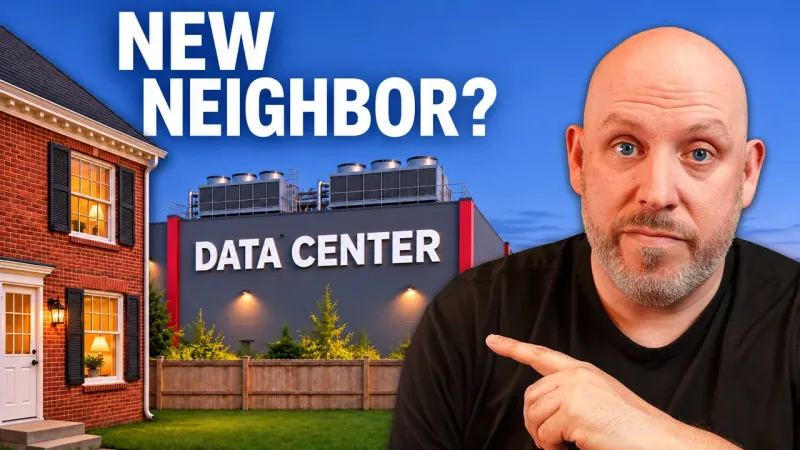
“Will a Data Center Hurt Your Atlanta Home Value? I Checked.” is a 13-minute video by Terence Richardson, a Realtor with Compass in Metro Atlanta. It was published on November 5, 2026 on his YouTube channel, Terence Richardson - Atlanta Real Estate.
Last year, more than 4 out of 10 homes listed within a mile of Atlanta's data centers failed to sell. Scary number, right?
So I went back and checked what actually happened: 158 data center sites, more than 130,000 listings, homes next door against homes a few miles down the road. Here's what the sales say about your home's value.
Transcript
This comes from YouTube’s automatic captions, set into paragraphs. One figure the captions misheard was corrected after checking it against the video’s script or a second transcription. Nothing else was added or reworded. Captions can still mishear a word or a number, so check a figure against the video before you rely on it. Captions read November 16, 2026.
What happens to homes near data centers? 0:00
Last year, more than four out of 10 homes listed within a mile of Atlanta's data centers failed to sell. Look, there are plenty of reasons to worry about living next to a data center. Your power bill, brown drinking water, the construction mess next door. But is your home's value one of them? Can you still sell it? Every story about these data centers is about what comes next. Almost nobody's gone back to check what already happened to the homes that are sitting right next to these sites here in Metro Atlanta.
So that is what I did. 158 sites, more than 130,000 listings, and I'm going to show you exactly what I found.
Every data center in metro Atlanta, mapped 0:38
Take a look at this map. Every dot is a data center that I could find. 58 are already running, 19 are under construction, 23 are approved, 36 are proposed, four are on hold under a county pause, and 18 were denied or withdrawn. Now, watch what happens when I play year by year. 20 new ones went public in 2024, 36 in 2025, and 12 so far this year. So of the ones that went public since 2014, almost four out of five came since January 2024.
As a matter of fact, Metro Atlanta now has more data center capacity under construction than anywhere else in North America. And counties are pushing back. Cobb, Cherokee, DeKalb, Paulding, Clayton all have hit the pause button on new projects. Now, those worries that I mentioned at the top, some of them are very real.
Power bills, tax breaks and jobs 1:32
Your power bill. Georgia Power says that about 80% of its next decade of growth is data centers. And last December, the state approved its biggest power build out ever just to keep up. Then there are tax breaks. Georgia gave up $474 million in tax revenue in one year. And the state's own auditors say that only three out of 10 of these projects came because of it. In other words, they would have come anyways even without the tax Then there are jobs, almost a billion dollar project in Clayton County, only 30 full-time jobs.
And next door, that construction, complaints about muddy runoff and bright lights and a lawsuit over well water that Meta disputes to this day. Now those are real. But notice something, your power bill and those tax breaks hit you whether you live next door or across town. So the question I keep getting is narrower. What does living next door to one do to my house?
The power lines on New Hope Road 2:31
So my in-laws live in Fayetteville and a year, maybe two ago, we were driving down New Hope Road and they were clearing trees, a lot of trees. I figured new neighborhood, right? Nope, Georgia Power clearing a path for power lines on poles almost 200 ft tall to feed the new QTS data center. Not long after, it felt like for sale signs were popping up everywhere along that road.
The test: next door vs down the road 2:57
Coincidence? So how do you actually check that? Well, the test is pretty simple. For every site, I took homes within a mile. That is considered next door. Then I took the homes one to 3 miles away from the same site down the road. Same area, same market, same interest rates, same years. So the thinking is if a data center hurts home values, next door should start falling behind down the road. If it doesn't, the two move together.
And notice what that means. Your power bill goes up the same next door as it does down the road. So this test, can't see it, it's built for one question. Does living next door cost you? Now I started the clock at the first news story or filing, not when it was built at the ribbon cutting. That's when buyers start hearing about it. I also ran everything on both Atlanta MLSs, Georgia MLS and FMLS.
That rules out any database quirks. Now I've been selling homes in these markets for 16 years and before I pulled a single record, I wrote down exactly how I tested and every change I made after I saw the data, it's logged right here for you to see. Whatever it said, that's what this video says. Now, I think you should stick around because I'm also going to show you two things that look like a finding but didn't hold up.
Part one: the scary number 4:13
So let's start with the number from the top of this video, failed listing. So what's a failed listing? Well, it's a home that hits the market and then comes off the market without selling. It either expired or was pulled or in our lingo, it was withdrawn. So take a look at this. In 2021, about one in seven listings within a mile of these sites failed. Last year, it was more than four out of 10.
So in 2021, if seven of your neighbors listed, one didn't sell. Last year, it was four out of 10 or call it close to three out of seven. Now that's a big, big jump and if that's all you saw, you'd think the data centers did that, right? Now take a look at the homes one to three miles down the road where you can't even see the building. Down the road, 42%. Next door, 41.9%.
And it's not just last year. Year after year, the two lines move together. So that's not the data center. That's the whole market just cooling and it hit everybody. And how long did it take to sell? Well, after the news, homes next door took a median of about 27 days. Down the road, 26 days. About a day. That's it. So no, a data center is not making homes impossible to sell around here.
Part two: the price 5:27
But look, selling isn't what costs you money, prices. A house can sell just fine and still sell for less. So that's the real test. So I took more than 50,000 sales and compared price per square foot next door versus down the road before and after the news and I adjusted for size, age, bedrooms, bathrooms, lot, and basement. So a big house next door doesn't make it look better than it actually is.
So before I show you, take a guess. Did the homes next door lose value? Let me know in the comments. Now here's what came back. No measurable drop. If anything, next door came back a hair higher, about 1%. Now see that shaded part, that's the margin of error. If homes next door really lost value, that whole bar would sit below the line. It doesn't, so I'm calling it zero. Now maybe it just takes time, right?
So I checked that year by year. The year it's announced, nothing. Year one, nothing. Year two, year three, nothing, nothing. Okay, so maybe it's the homes right up against it. Half a mile, a mile, two mile, all flat. Being closer did not make it worse. And here's what's interesting. Take a look at the ones that have been around the longest. QTS in Fayetteville, Microsoft in Palmetto, and in East Point, the two CleanSpark sites in College Park and Norcross.
Homes near the ones already built held up fine. What about the projects that died? Project Oak in Coweta got voted down unanimously in August across the denied and withdrawn sites, no lasting mark on home prices. But maybe the damage hides somewhere else, so I checked that too. Seller concessions, price cut, cash buyers, foreclosure. And remember those for sale signs in Fayetteville on New Hope Road? I checked whether people rushed to list the year the news broke across all these sites, and they didn't.
No rush to sell, no extra discounting, no wave of investors. Now to be fair, one national working paper found prices about 7% lower within 3 miles of new big tech campuses. But that's not what Atlanta sales show. As a matter of fact, realtor.com looked at 43 zips around the country and found no measurable price effects in the first two years.
The skeptic check: what didn't hold up 7:44
Now I promised you two things that didn't hold up. I found a couple of hints and I ran them through the same tests. Hit number one, near the very newest announcements, listings failed a few points more often than down the road. So I ran a placebo test like a sugar pill in a drug trial. I dropped fictitious data centers at random spots a couple of miles away and then looked at the data.
There was nothing there. If the fictitious one show the same jump, the real ones aren't proving anything. About one time in eight, they did. See the real one? Out towards the edge, but not by itself. And the real site split right down the middle. About half went up, half went down. So there's no part of me that can sell that to you as a fact. Now hint number two. One way of tracking the exact same houses actually did show a gap.
Then I checked it in the other MLS on the same sites and it was gone. So that one's out too. And there's two honest limits. Like most of these sites are less than two or three years old. So there is the possibility that a slower effect could show up at some point in the future. And this measures prices and sales, not noise, not light, not what it's like to actually live there.
So data centers don't matter at all? Not so fast. Because there's one place in Metro Atlanta where the homes next door really did fall behind.
The exception: the Lithia Springs corridor 9:06
Lithia Springs, the Douglas County corridor. Google's been there for years. Then came Switch, Stack, Microsoft, and a whole row of others. And take a look at this. Homes right by the corridor fell about 20% behind homes a couple of miles away. That's $1 out of every five, and that happens to be huge. So that's the data center, right? Well, here's the thing. Watch where the line starts to drop. The slide started before the big wave of data centers showed up.
So I can't tell you that the data centers caused it. But what I can tell you is what that corridor is. It's interstate, rail, warehouses, and data centers since the late '90s. One heavy use after another stacked up over decades. That's the real risk. Not one building, but an actual corridor. Back in 2016, I had a client who fell in love with a neighborhood called Tributary. It's right off of Riverside Parkway.
Pool amenities, beautiful houses, quick shot to I-20 and 285. And he ended up passing on the neighborhood. Why? He was worried that one day they'd put warehouses across the street because there were warehouses down the street. Well, take a look at this. Across the street they built apartments and right behind those warehouses and data centers with more going up. Turns out he wasn't worried about one building. He was worried about what comes next to it.
So here's what to watch. Not just the one site in the news, everything that's built, zoned or proposed within a few miles of you, right? Is your area turning into a corridor?
What to do if you're buying or selling 10:42
So what do you actually do with all of this? I think it depends on where you're sitting. If you're buying, a data center within a mile is not a discount coupon. The sales don't support knocking money off just because one got announced. But do your homework. Find out what's built, zoned or proposed around the house, not just the one site in the news. That's 10 minutes on a 30-year decision. And I'll show you a free way to check that here in just a little bit.
And then go stand in the backyard. The numbers can't hear the hum. You can. Now if you're selling near a newly announced site, don't panic. The failure rate you're scared of is the whole market and it's the same as a few miles away. Price it for the market, not necessarily for the headline. Now will some buyers see a data center on the map and cross your house off the list? Absolutely. That fear happens to be real.
But across these sites, enough buyers didn't. Homes next door sold just as often, just as fast with no measurable discount. So don't price in a discount the sales don't support. If you're fighting a rezoning, I know the first argument everyone reaches for is it's going to kill our property values. And look, a lot of people do believe that. But so far, Atlanta sales just don't back it up. And if you can't prove it, it's not your strongest card.
I'd bring the arguments you actually can back up, right? Noise limits, setbacks, water, traffic, power lines, the tax deal and whether your area is becoming a corridor.
The verdict 12:09
So here's 130,000 listings in one sentence. Homes near Atlanta's data centers sold just as often and they held their value. The scary number is the market, and the real risk is your area turning into an industrial corridor. Now, I know that's not what a lot of people expected to hear in this video. Data centers are easy to be mad at right now, and some of that is definitely earned. Probably a lot of that is earned.
But I'm not here to tell you how to feel about them. I'm here to tell you what the actual data says. And right now, in Atlanta, that's what they say. If that changes, I'm going to keep an eye on it. I'll be the first to let you know. And if you live near one and you're seeing something different, let me know in the comments.
Check your own address 12:51
I read every single one. Now, it took a lot of research to find out where these data centers are actually located. So I built a tool. If you own or rent a house and you want to know where the data centers are around you, is your house close to one, go to the link in the description and that first comment. You don't have to sign up for anything. No name, no email.
I don't even record the address. But it will show you where your house is relative to those data centers in a one and three mile ring around it. Now, if you're going to watch more videos today, YouTube definitely thinks you should watch this one next. Thank you so much for watching, and I hope to see you on the next one.

About Terence Richardson
Terence Richardson is a Realtor with Compass and the founder of the Terence Richardson Group, which serves Metro Atlanta. He publishes Atlanta’s Housing Market Update every month on YouTube and in The Richardson Report.